|
|||||
 |
|||||
|
|||||
|
Is Dividend Income Safe?
After the collapse of the Internet bubble many investors turned to the relative safety of dividend income. At the risk of being labeled a "gloomy Gus", I have to point out that dividends aren't 100% safe. The intrepid dividend investor must be on the constant lookout for dividend cuts, inflation and high prices. The list of ex-dividend-paying firms is depressingly long and littered with many fallen blue-chip stocks. For instance, Laidlaw, a past "Dog of the TSX", cut its dividend before slipping into bankruptcy a few years ago. Alternately, Bombardier rattled shareholders this year with a dividend cut. Of course, it's easy to pick on failed dividend stocks. To get a better sense of dividend stability it is useful to turn to the broad markets where you can see how well dividends do during hard times and market crashes. Robert Shiller's annual data on the S&P500 provides a good source of dividend information because it goes back to the 1870s. (During the early years predecessor indices were used.) Simply plotting dividends paid by the S&P500 on a graph would show impressive gains. However, such a graph would be misleading without taking inflation into account. Inflation is the rate at which the general level of prices for goods and services increases. Think of it this way, back in 1936 a youthful Warren Buffett was buying 6 cokes for $0.25 and selling them individually for a nickel. Young modern-day Buffetts would have to pay much more than $0.25 for a six-pack of coke and the same goes for other daily products. If dividends don't grow faster than inflation, then a dividend-oriented investor might have to cut back. Figure 1 shows a plot of dividends paid by the S&P500 adjusted for inflation (based on the consumer price index). Thankfully, the overall trend has seen growth in inflation-adjusted dividends but there have been prolonged periods when dividends did not keep up with inflation. Based on the historical record, investors who rely on dividends for their retirement needs could be in trouble should they lack sufficient reserves for bad times. 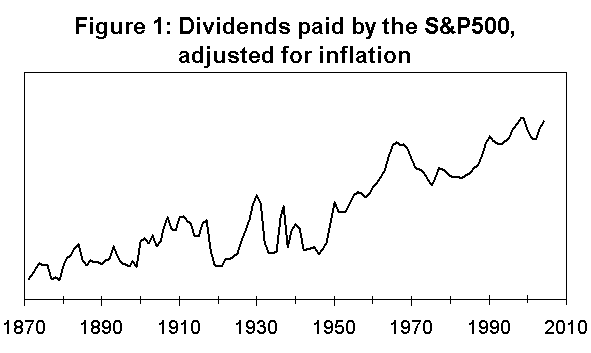
Figure 2 shows the percentage decline in inflation-adjusted dividends from their prior peak. For instance, inflation- adjusted dividends paid by the S&P500 reached a new high in 1911 but they then declined unevenly until they were reduced by 47.8% in 1920. The old 1911 high was only surpassed in 1929. As a result, an investor retiring in 1911, who needed full dividend payments to ensure a happy retirement, could have passed away before his dividend income recovered in inflation-adjusted terms. 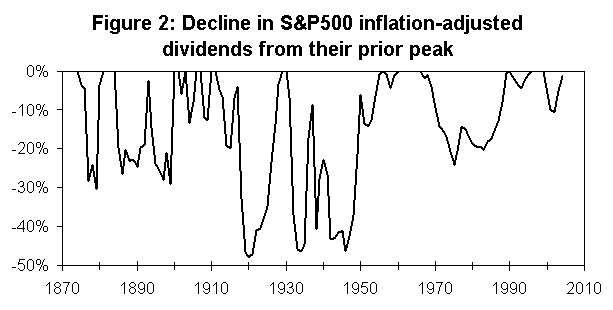
The next prolonged period of dividend distress began shortly after 1929. Starting from a new peak in 1930, dividends dropped by 46.3% in 1934, recovered a bit and then fell back to similar levels in 1946. It was only in 1956, some 26 years later, that the S&P500's inflation-adjusted dividend surpassed 1930 levels. Ten years latter, and after a very good run, inflation-adjusted dividends hit another high in 1966. This time dividends fared better with declines of "only" 24.1% by 1975. It took some 24 years to break beyond the 1966 dividend peak in 1990. The three down periods represent some 68 years of the last century. To be sure, you would have been unlucky to buy right at the top but 28% of the time the S&P500 has yielded smaller inflation-adjusted dividends ten years after purchase. To put it in more practical terms, how would you feel if your dividend-based retirement income was cut from $40,000 per year to $32,000 or even to $24,000? You might be faced with the choice of selling stock, possibly during depressed market conditions, or switching from eating steak to tinned tuna. As a fan of frugal living, I enjoy tuna but I would also like to be able to buy steak. Naturally, changes in stock prices tend to be even more extreme than changes in dividends. The lesson is not to avoid dividend stocks but to be aware that dividend income is not a guaranteed road to riches. In the end, it is important to remember that I remain enthusiastic about reasonably-priced dividend stocks. Just keep in mind that some of them will inevitably perform poorly. Date: July 2005 More Dividends |
|||||
| |||||
| |||||
| Disclaimers: Consult with a qualified investment adviser before trading. Past performance is a poor indicator of future performance. The information on this site, and in its related newsletters, is not intended to be, nor does it constitute, financial advice or recommendations. The information on this site is in no way guaranteed for completeness, accuracy or in any other way. More... | |||||