|
|||||
 |
|||||
|
|||||
|
Stock Mortality
Stocks can disappear by going bankrupt or by being bought out. In this article I look at the probability of such events and review a few ways to profit from them. Evidence of stock mergers and liquidations can be found in the TSE Review magazine. From December 31 1979 to December 31 1999 the average annual disappearance rate for stocks was 7.4% with a high of 12.6% and a low of 4.1% (See Figure 1). The disappearance rate represents the annual chance that a common, or preferred, stock will be delisted from the exchange. This rate includes companies that delist for financial reasons and those that disappear when they are taken over by another company. I didn't include delistings that occurred at the request of the company. After all, a company listed on both the NYSE and TSE might decide to stop trading on one exchange for reasons other than financial distress or merger activity. 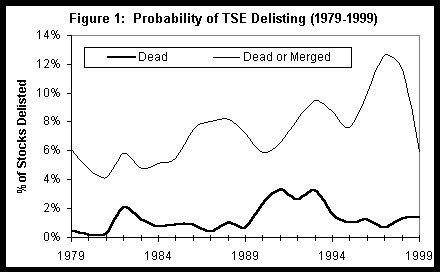
A 7.4% annual disappearance rate makes it hard to hold a stock forever. After all, there is a 50% chance that a stock will disappear every 9 years which seems to be a practical time limit for planning purposes. It is also interesting to look beyond stock disappearance to stock mortality. Stock mortality is the likelihood of a stock being forced off the exchange due to financial distress. This includes stocks that have been delisted for reasons such as "following suspension", "no longer meets listing requirements based on the company's financial condition", "liquidated by order of B.C. supreme court" or "after cease trade order by the OSC". After a bit of work I found that from 1979 to 1999 the annual mortality rate for TSE listed stocks averaged 1.3% and that it reached a high of 3.3% and a low of 0.2%. How can you benefit from stock disappearance or from stock mortality? You could try short selling or attempt to buy merger candidates or you could simply try to avoid taking a loss. Loss avoidance is the easiest route and can be largely achieved by buying stocks with low debt levels and stable or increasing earnings. As a general rule, I look for companies with debt-to-equity ratios of less than 25% and earnings in each of the last five years. It is also reassuring to see a ratio of current assets to current liabilities of two or more. Such an approach helps one to avoid bankruptcies but it may lead to an increased chance of being bought out. Trying to buy merger candidates can be quite profitable as investors are usually offered a premium to market prices. In this case, investors should look for companies that trade at less than book value and have little or no debt. In this case, assets are probably more important than short-term earnings. However, you should avoid companies in significant distress. In this situation a buyer can always wait for a lower price and then snap up the pieces. So, viable stocks with good balance sheets are the way to go. It is hard to profit from the dark art of short selling since markets generally move higher and the short seller must work against this trend. If you are interested in short selling I recommend reading The Art of Short Selling by Kathryn Staley. It is an excellent primer and a fun tour through the dark underbelly of investing. As we head into a period of economic weakness I expect that more stocks will vanish due to financial distress. If history is a good guide the stock mortality rate may creep up to near 3% in the next few years. Can your portfolio weather the storm? First published in May 2001. |
|||||
| |||||
| |||||
| Disclaimers: Consult with a qualified investment adviser before trading. Past performance is a poor indicator of future performance. The information on this site, and in its related newsletters, is not intended to be, nor does it constitute, financial advice or recommendations. The information on this site is in no way guaranteed for completeness, accuracy or in any other way. More... | |||||